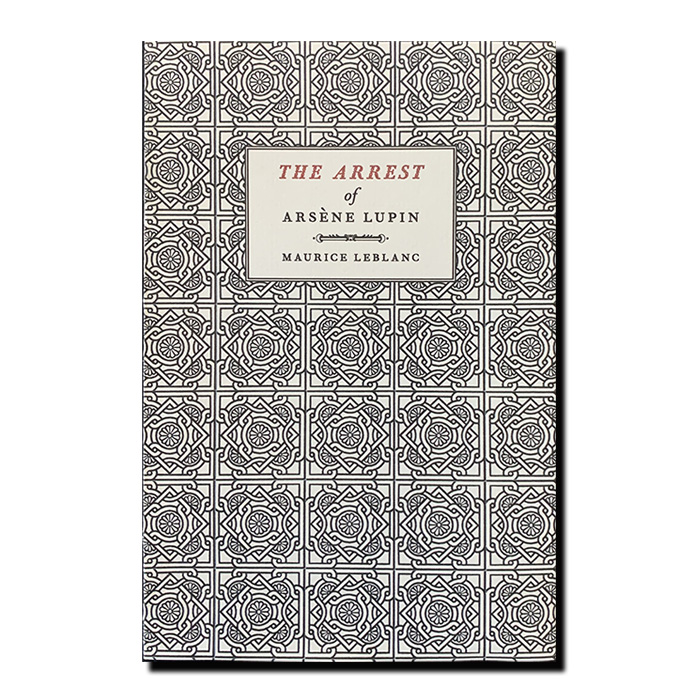
First published in the French magazine Je sais tout in 1905, “The Arrest of Arsène Lupin” serves as the introduction to the iconic gentleman burglar. A staple of early crime fiction, LeBlanc’s mysterious and masterful professional criminal is the anti-Sherlock Holmes, constantly confounding the public and police alike with his ability to “commit a crime without actually being present” and even meeting fiction’s greatest detective (unsubtly given the name Herlock Sholmes) in a later story.
This novella of Arsène Lupin establishes the character as one of the greats of French crime literature with the mysterious arrival of a telegram to the passengers aboard a vessel bound for America announcing that the infamous burglar is on board the ship. But which traveler is really this master of disguise in disguise? It is up to the passengers on the ship to determine the false identity of Lupin before they dock in America, where Lupin’s nemesis, the famed Inspector Ganimard, is waiting.
Lupin is to Robin Hood as Ganimard (and in many ways, Holmes) is to the Sheriff of Nottingham; Lupin often takes from the rich to give to the poor. LeBlanc’s debonair gentleman thief was adapted into film as early as 1908, with the Hollywood film “The Gentleman Burglar” featuring William Ranows as Lupin. Most recently, the character and stories serve as the inspiration for the acclaimed Netflix series, Lupin, which uses Lupin as the muse of a new-age gentleman thief played by Omar Sy.
With a gasp-inducing plot twist, “The Arrest of Arsène Lupin” cements LeBlanc’s writing as foundational to crime literature as we know it today. This Dispatch will feature the text of this iconic French crime story in the original French and the English translation.
What better way to celebrate the beginning of spooky season than by subscribing to the Dispatch to receive this most iconic of crime stories? It’s also not too early to start thinking about holiday gifts- “The Arrest of Arsène Lupin” makes the perfect winter holiday present for any crime fiction lover!
Maurice LeBlanc was a French novelist and writer of short stories, and was best known for his character Arsène Lupin, who is thought of as a French counterpart to Arthur Conan Doyle’s Sherlock Holmes. LeBlanc’s first Lupin story appeared as a series of short stories in literary magazine Je sais tout, but was so successful that he dedicated the rest of his life to writing full-length Lupin stories. LeBlanc’s writing style is a quintessential example of Belle Époque French literature, and he was known for masterfully combining the thrill of adventure with the puzzles of detective fiction. He often broke the fourth wall, mimicking his character’s charming but intensely intellectual personality and encouraging readers to solve the puzzles alongside his characters.